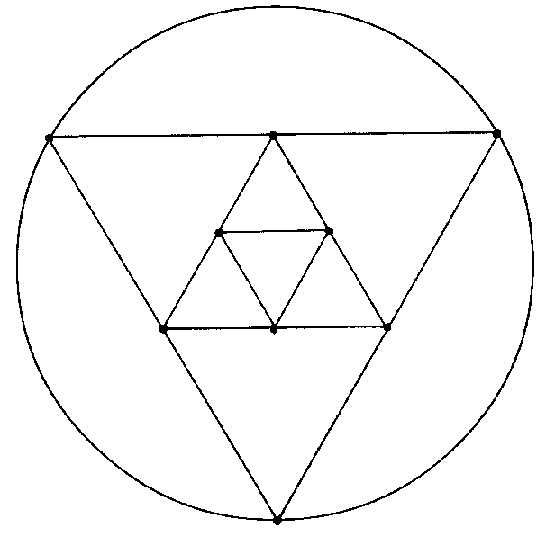
3 x 3
The 4000 year old game of Go has foreseen this development. Opposite to chess, there is no hierachy within the stones. There are no kings, queens, bishops and pawns. All stones (of one colour) look alike, are equal and get their worth just by their position on the board. It is not the aim of the game to destroy the opponent but to share given resources with a partner in a competitive way.
It is remarkable that a game with this ideas was held high by the feudal systems of ancient China and Japan.
Now the time has come to go a step further.
If you look critical at the Go board, you will find out that there is still a hierachy within the crossing points of the board. You will see centre points share four lines with their neighbours. Border points have only three of these lines and corner points just two.
This has to be changed. The Go board of the future will have crosspoints with four neighbours each. This means that it is a board without borders and corners.
To play on this board will lead to a total new playing technique.
You can’t rely on the old josekis because there will be no corner to play them. There will be no third line to make territory and there will be no fourth line to get influence.
If you play a ladder, you can’t rely on the border to stop your opponent from escaping. You will have to place a stone of your own to do this job.
I want to invite you to take part in this development.
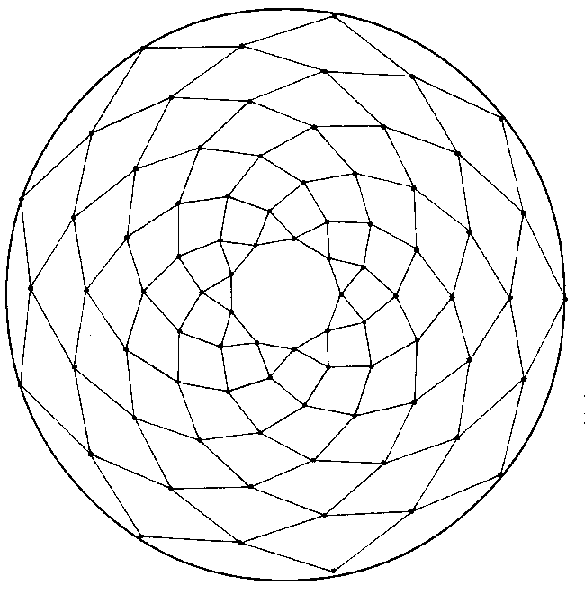
It should be possible to organize a tournament on this new borderless goban during this congress. I think it should be played on a side tournament on Tuesday of the second week. This will give you time to practise the new techniques.
You can try to play on the example board which is included in this magazine. This board is of the size 3x3 points. A larger board with 9x9 points will be available soon. Please contact me for copies.
I should remark that these boards are not borderless at all. To make them borderless it would have been necessary to produce a three dimensional object, which means that the boards have the form of a torus or doughnut. We didn’t do this step do reduce production costs.
 |
 |
 |